The Club
About Shoothill United
Founded on the banks of the Riverside in 1902.
The History of Shoothill United
Formed in 1902 by workers from the old Riverside Mills, Shoothill United has been at the heart of the community for well over a century. From humble beginnings on a marshy pitch beside the river, the club has grown into one of the region’s best-supported sides.
The club’s earliest players were drawn from the mills, foundries and railway yards surrounding Shoothill. Matches were initially played on Sunday afternoons against factory teams from neighbouring towns, with players changing in a nearby public house and carrying the goalposts to the pitch themselves.The club’s original colours were dark grey and white, chosen to reflect the smoke, stone and steel of the industrial town.
Shoothill United entered its first organised league in 1906 and quickly developed a reputation for determined, physical football. Promotion followed four years later, while growing crowds encouraged the club to move to a more permanent home. In 1912, United opened the original Riverside Ground on land provided by the mill owners. Its first wooden stand could accommodate 600 spectators, although considerably more regularly gathered around the touchlines.
Competitive football was interrupted by the First World War, during which many players, officials and supporters served overseas. The club resumed playing in 1919, adopting the bright blue shirt that would later become central to its identity. According to local tradition, the colour was chosen to represent the river on a clear summer morning and the sense of renewal felt throughout the community.
The 1920s brought Shoothill United its first sustained period of success. The club won the County Cup in 1924 and again in 1928, with the second victory attracting thousands of supporters to the town centre for an open-top tram parade. A covered terrace was added to the Riverside Ground soon afterwards, funded partly through collections made at local factories.
United’s progress slowed during the economic difficulties of the 1930s. Falling attendances and the closure of several local employers placed the club under considerable financial pressure. It survived through the efforts of supporters, who organised fundraising matches, dances and weekly collections. This period established the close relationship between the club and its community that continues today.
Following another interruption during the Second World War, Shoothill entered a new era. The late 1940s and 1950s saw crowds rise sharply, with supporters frequently packed onto trains and buses for away fixtures. In 1953, United recorded its first major national cup upset, defeating top-flight opposition at a rain-soaked Riverside Ground. The result became known locally as the “Riverside Miracle” and remains one of the most celebrated matches in the club’s history.
The club’s first league championship arrived in 1961 under manager Arthur Vale. His side was built around a disciplined defence, energetic local midfielders and prolific centre-forward Tommy Cross, who scored a club-record 38 goals during the campaign. Promotion was secured on the final day in front of a record home crowd.
Shoothill remained competitive throughout the 1960s but endured a difficult period during the following decade. Relegation, financial uncertainty and the deterioration of the Riverside Ground threatened the club’s future. In 1976, supporters formed the Shoothill United Preservation Fund, raising enough money to prevent the sale of the ground and keep the club operating.
The revival began in the early 1980s. A talented group of academy graduates helped United climb back through the divisions, while the club introduced its now-famous circular crosshair crest. The design represented precision, ambition and the historic engineering industries of Shoothill. The Latin motto **Semper In Scopo**, meaning “Always on Target”, was later added beneath it.
One of the club’s greatest seasons came in 1987, when Shoothill won promotion and reached the semi-final of the National Cup. Thousands travelled to the neutral venue, creating a sea of blue in the stands. Although United narrowly lost the match, the campaign restored pride in the club and inspired a new generation of supporters.
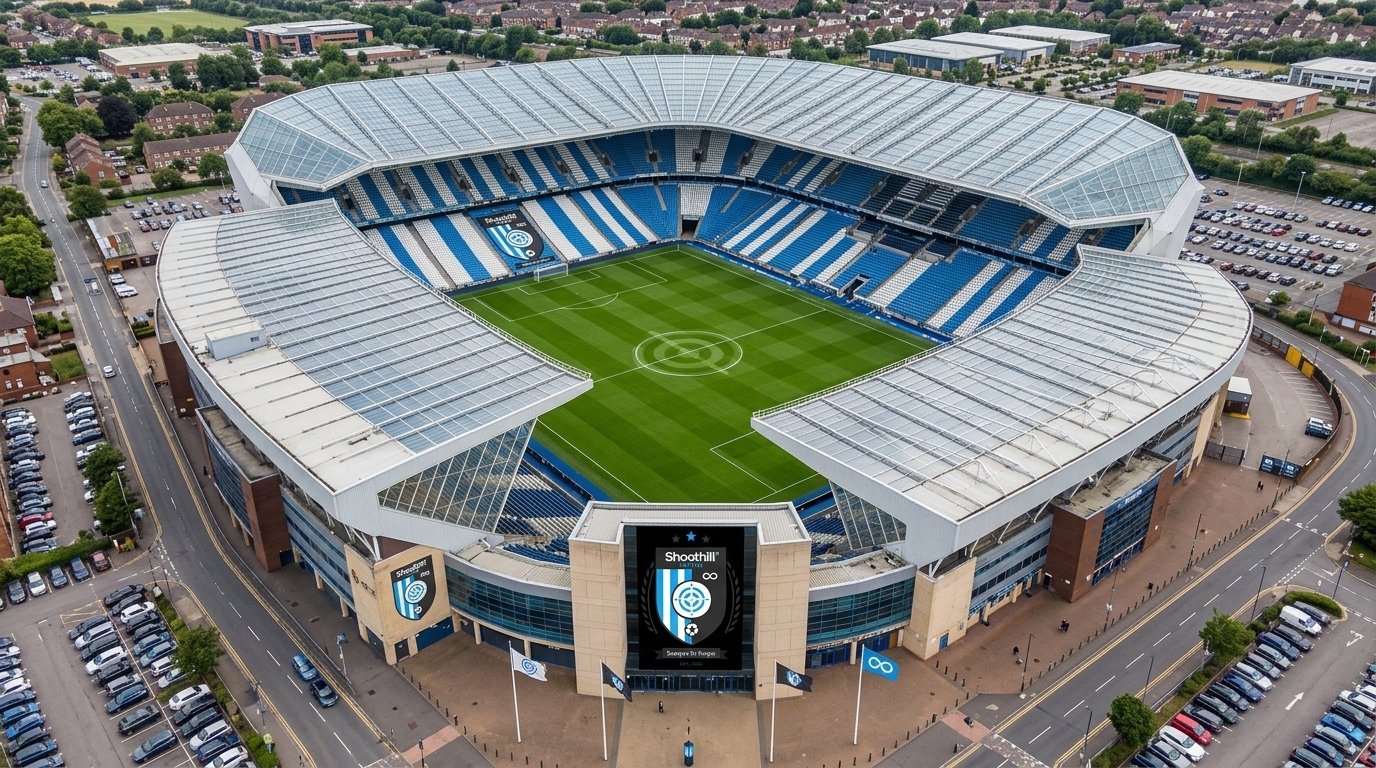
The Riverside Ground underwent major redevelopment during the 1990s. Its old wooden stands were replaced, floodlights were upgraded and new family areas were introduced. The stadium retained its original location beside the river, ensuring that the club remained physically and emotionally connected to the community that created it.
Shoothill celebrated its centenary in 2002 with a commemorative match, a town-centre exhibition and the unveiling of a memorial dedicated to former players and supporters. Four years later, the modern club identity was officially introduced, including the current crest and the establishment date of 2006 marking the beginning of a renewed era for the organisation and its wider community programmes.
Recent decades have brought promotions, relegations, dramatic cup runs and several near misses. Through every change, the Riverside Ground has remained one of the region’s most atmospheric venues. Its steep stands, close touchlines and passionate support have made it a difficult place for visiting teams.
The club has also developed a strong academy, community foundation and women’s programme. Thousands of local children now take part in coaching, education and outreach projects carrying the Shoothill United name. Many first-team players have progressed through the youth system, maintaining the club’s tradition of giving opportunities to local talent.
Today, Shoothill United continues to represent the resilience and character of the town. The mills that gave birth to the club may have disappeared, but their influence remains visible in its identity, values and support.
From a marshy riverside field to a packed modern stadium, the story of Shoothill United is one of perseverance, community and ambition. Generations of players have worn the blue shirt, but the purpose of the club has never changed: to bring the people of Shoothill together and give them a team they can call their own.
This club is the beating heart of the Riverside. Always has been, always will be.
— Club President